Hosted within the IEEE MCSoC 2027 Forum
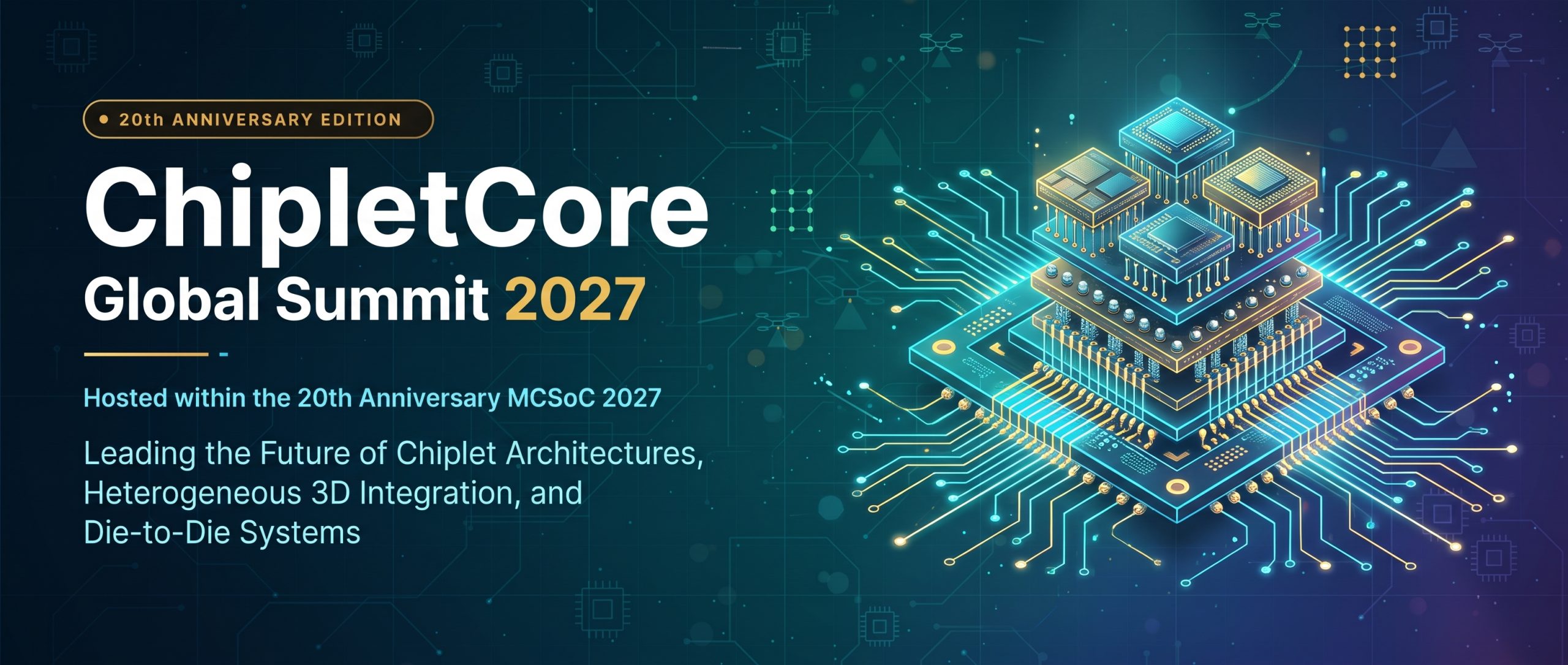
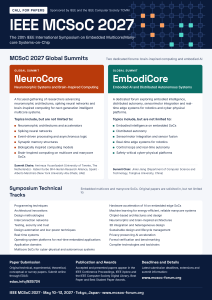
Download the MCSoC-ChipletCore 2027 flyer (PDF)
The 2027 ChipletCore Global Summit on Chiplet Architectures and Heterogeneous 3D Integration is organized within the IEEE MCSoC Forum program and serves as a dedicated venue for advancing next‑generation multi‑die and chiplet‑based systems. ChipletCore focuses on the architectures, interconnects, packaging technologies, and design methodologies that make it possible to build scalable multicore and many‑core systems from heterogeneous chiplets—spanning die‑to‑die interconnects (UCIe and beyond), 2.5D/3D integration, thermal and power co‑design, test and reliability, and hardware security. As monolithic scaling slows, ChipletCore provides a focused forum for breakthroughs that turn disaggregated silicon into efficient, trustworthy, and cost‑effective computing platforms for AI, HPC, edge, and embodied systems.
2027 ChipletCore Summit Chairs

Summit Chair
Lichen Weng
SoC Architect
Tenstorrent Inc., USA

Summit Co-Chair
Chun-Ming Huang
Taiwan Semiconductor Research Institute
(TSRI), Taiwan
Topics of Interest
- Track1: Chiplet-Based Multicore and Many-Core System Architectures
Track Chair: TBC- Modular chiplet partitioning and system-level architectural exploration.
- Heterogeneous compute, memory, and I/O chiplet disaggregation strategies.
- Scalable multi-die topologies and cache-coherent chiplet fabrics.
- Domain-specific chiplet platforms for AI, HPC, and edge computing.
- Cost, yield, and performance trade-offs in chiplet-based SoC design.
- Track2: Die-to-Die Interconnects, Protocols, and Network-on-Package (NoP)
Track Chair: TBC- High-bandwidth, ultra-low-energy die-to-die (D2D) physical layer and link design.
- Open interconnect standards and interfaces (UCIe, BoW, OpenHBI, CXL-over-D2D).
- Network-on-Package (NoP) routing, flow control, and deadlock-free topologies.
- Latency, bandwidth density, and energy-per-bit optimization across interposers.
- Optical and wireless chip-to-chip and die-to-die interconnect technologies.
- Track3: 2.5D/3D Heterogeneous Integration and Advanced Packaging
Track Chair: TBC- Silicon interposers, organic substrates, and embedded bridge packaging (EMIB).
- 3D die stacking, hybrid bonding, and Through-Silicon Via (TSV) architectures.
- Near-memory and 3D-stacked memory integration (HBM, 3D DRAM/SRAM).
- Co-design of silicon chiplets with package-level routing and bump maps.
- Mechanical stress, warpage, and physical design rules in 2.5D/3D packages.
- Track4: Thermal Management, Power Delivery, and Signal Integrity in Multi-Die Systems
Track Chair: TBC- 3D thermal modeling, hotspot mitigation, and microfluidic/active cooling strategies.
- Power Delivery Networks (PDN), integrated voltage regulators (IVRs), and backside power.
- Signal and power integrity (SI/PI) across high-density interposers and TSVs.
- Thermal-aware task scheduling, DVFS, and runtime workload migration across chiplets.
- Electro-thermal-mechanical multi-physics co-simulation methodologies.
- Track5: EDA Tools, Modeling, and Co-Design Flows for Chiplets
Track Chair: TBC- Cross-die synthesis, floorplanning, partitioning, and place-and-route algorithms.
- System-Technology Co-Optimization (STCO) and early pathfinding frameworks.
- Standardized chiplet description languages, PDKs, and behavioral models.
- Full-system virtual prototyping and cycle-accurate multi-die simulation.
- AI/ML-assisted design-space exploration for heterogeneous chiplet assemblies.
- Track6: Testing, Known-Good-Die (KGD) Assurance, Reliability, and Fault Tolerance
Track Chair: TBC- Pre-bond and post-bond testing methodologies for Known-Good-Die (KGD) assurance.
- IEEE 1838 3D test access architectures, boundary scan, and Built-In Self-Test (BIST).
- Interconnect redundancy, lane repair, and TSV/micro-bump fault tolerance.
- Aging, electromigration, and reliability modeling in 3D stacked chiplets.
- Online health monitoring and resilient failover mechanisms for multi-die systems.
- Track7: Hardware Security, Trust, and Supply-Chain Integrity in Chiplet Ecosystems
Track Chair: TBC- Zero-trust architectures and cryptographic authentication between multi-vendor chiplets.
- Protection against malicious chiplets, hardware Trojans, and interposer probing.
- Side-channel and fault-injection attacks across die-to-die interfaces.
- Secure boot, root-of-trust chiplets, and lifecycle management in open ecosystems.
- Supply-chain provenance and anti-counterfeiting for disaggregated silicon.
- Track8: Heterogeneous Chiplets for AI, Neuromorphic, and Embodied Systems
Track Chair: TBC- Chiplet-based accelerators for foundation models, generative AI, and edge inference.
- Integration of neuromorphic, analog/in-memory, and digital compute chiplets.
- Sensor-compute-actuator chiplet platforms for robotics and embodied AI.
- Automotive, aerospace, and safety-critical multi-die SoC architectures.
- Open-source RISC-V chiplet platforms, silicon prototypes, and taped-out case studies.
Paper Submission
All papers must be submitted electronically through EDAS. Authors are encouraged to review the detailed submission instructions before uploading their manuscripts.
Proceedings Publication and Indexing
Indexed by

Published in

The conference proceedings, including all technical tracks, special tracks, and workshop papers, will be published by IEEE Conference Proceedings and included in the Computer Society Digital Library (CSDL) and IEEE Xplore, subject to meeting IEEE Xplore’s scope and quality requirements.